Growth
Govern the human conditions that decide whether expansion strengthens or strains the organization.
- Leadership capacity
- Manager consistency
- Role clarity
- Trust during scale
 Human Performance
Growth. Operations. Transformation.
Growth, operations, and transformation are concurrent leadership conditions, not a sequence. Pro Living helps teams see the human-performance issues that determine whether each one scales, holds, or stalls.
Govern the human conditions that decide whether expansion strengthens or strains the organization.
Govern the day-to-day patterns that determine reliability, workforce stability, and service continuity.
Govern the human side of change so new systems, strategies, and missions become adopted behavior.
National Benchmarks
These public benchmarks show the scale of movement, pressure, engagement, and benefit cost leaders are already managing. They frame the environment for human-performance governance; they are not Pro Living client results.
Gross job gains from expanding and opening private-sector establishments from September to December 2025.
Source: BLS Business Employment DynamicsAnnual hires in 2025, with 62.8 million total separations across the same total nonfarm population.
Source: BLS Job Openings and Labor TurnoverAverage share of U.S. employees actively engaged at work in 2025, unchanged from 2024.
Source: Gallup WorkplaceAverage annual premium for employer-sponsored family health coverage; workers contributed $6,850 on average.
Source: KFF Employer Health Benefits SurveyNational benchmarks describe the operating environment. They are not HPGA client results.
How It Works
HPGA governs human-performance risk across growth, operations, and transformation. HPIN turns human and operational signals into governed intelligence. Governance Agents convert reviewed intelligence into assigned follow-through.
Sets standards, decision rights, responsible-use boundaries, and executive accountability.
Connects signals from existing systems and human-performance inputs into role-aware intelligence.
Review context, assign action, support follow-through, and keep responsibility human-led.
Pro Living sits above technology investments instead of asking leaders to rip and replace them.
Signals are interpreted through policy, context, permission, and human judgment.
Governance is complete only when the next owner, cadence, and review point are clear.
Human Operators
Governance Agents are trained human operators who help leaders interpret governed intelligence, coordinate response, and maintain execution discipline. They are not AI assistants and they do not make independent personnel, clinical, legal, or financial decisions.
Explore Governance Agents →Inspect signals, context, and permissions before any intervention is recommended.
Connect the right owner, partner, or internal leader to the governed action.
Track commitments, evidence, operating rhythm, and the next executive review point.
The HPGA Operator Pathway connects veterans and former professional athletes with paid operator opportunities and professional development toward franchise ownership, business ownership, or becoming a high value employee.
Command Center
Executive visibility should show where human-performance conditions are strengthening or breaking down, who owns the next action, and whether follow-through changed the condition being governed.
 Human Performance Command Center
Illustrative interface. Displayed metrics are demonstration data.
Baseline First
Pro Living starts with an organization's own operating baseline before discussing potential value. That baseline helps leaders understand where performance risk exists today and how changes should be measured without double counting the same impact across multiple categories.
Discuss Your Organization's BaselineClarify where movement is normal, where it is costly, and which teams require governance attention.
Track whether handoffs, role clarity, and follow-through are improving or creating repeated drag.
Connect observed needs to responsible support pathways without turning governance into a sales funnel.
Measure whether transformation is becoming trusted behavior, not simply completed implementation.
Economic discussions should use one baseline, one measurement logic, and no double counting across categories.
Industries
The same human-performance governance discipline adapts to the mission, operating model, workforce, and risk profile of each environment.
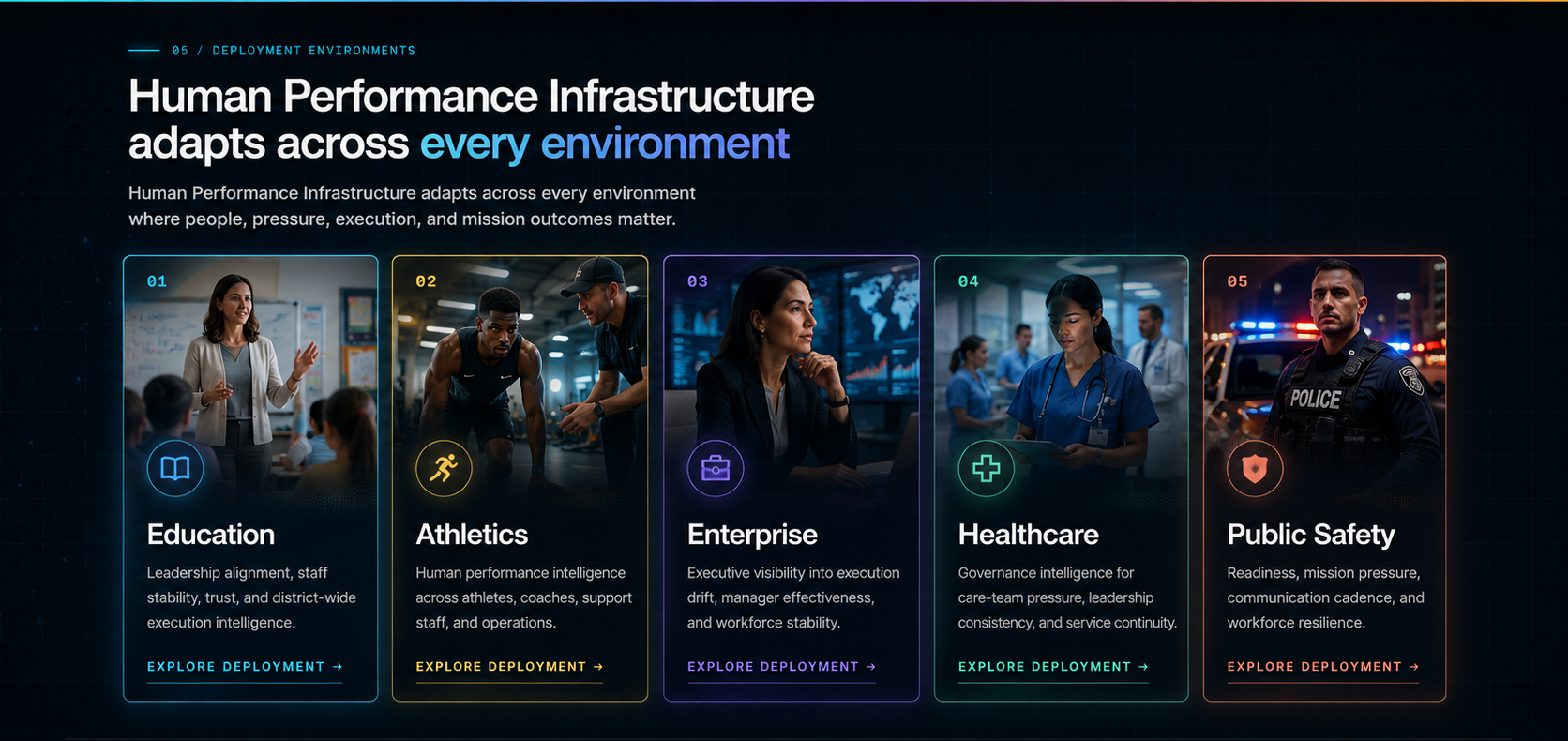
Govern strategy alignment, leadership effectiveness, execution drift, workforce stability, trust, and transformation adoption.
Explore Deployment →Govern mission readiness, communication, workforce pressure, public trust, and coordinated response across civic systems.
Explore Deployment →Support adult staff and organizational governance across leadership, faculty, operations, communication, and district or campus execution.
Explore Deployment →Govern performance environments across coaches, administrators, athletes, support staff, retention, culture, and execution discipline.
Explore Deployment →Govern leadership alignment, care-team pressure, communication breakdowns, workforce stability, and service continuity.
Explore Deployment →Research Partnerships
Pro Living research partnerships are designed to establish baseline conditions, evaluate governance interventions, and report what changes with appropriate evidence discipline.
Focus Leadership • Staff Stability • District Execution
Focus Retention • Trust • Human Performance Risk
Focus Leadership • Execution • Workforce Stability
Research status reflects existing site positioning and does not create new validation claims.
Responsible Governance
Human-performance intelligence must be used for defined organizational purposes, reviewed by people, and limited by role, context, permission, and decision authority. Pro Living designs HPGA and HPIN around responsible use rather than individual surveillance.
From the Human Performance Journal
Explore current Journal articles that explain why wellness, infrastructure, and execution need governance discipline.
Governance Article
Foundational Framework
Executive Briefing
Whether your organization is scaling, stabilizing operations, or leading transformation, Pro Living can help define what human-performance governance should measure, who should own follow-through, and how leadership should review change over time.